Why Malaysian SMEs Should Look Beyond Salary Budgets and Rethink Pay Conversations
For many Malaysian small and medium-sized enterprises (SMEs), attracting and retaining talent has become a growing business challenge. Rising employment costs, changing workforce expectations and increasing competition from larger organisations are prompting SMEs to reconsider how they attract skilled employees when they may not have the financial capacity to offer the highest salaries. However, competing for talent is increasingly about more than the size of a monthly paycheque.
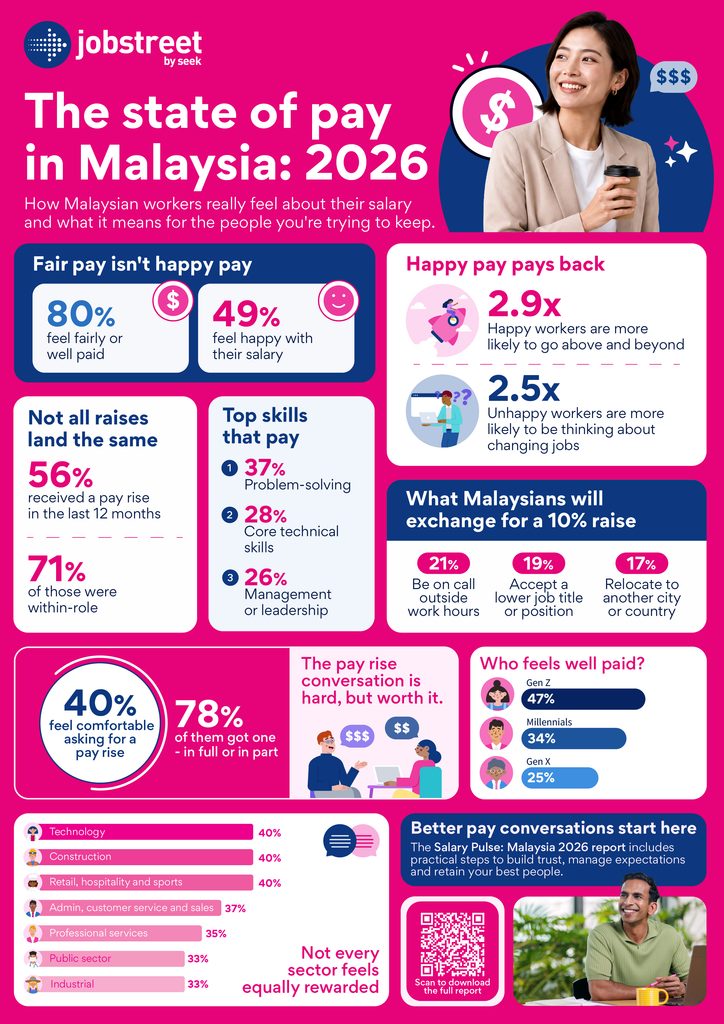
Findings from Jobstreet by SEEK’s Salary Pulse 2026 suggest that employees are placing greater importance on understanding how they are rewarded, recognised and supported throughout their careers. As SMEs account for 96% of Malaysia’s business establishments and contribute nearly 40% of the country’s GDP, developing a competitive workforce is crucial to sustaining economic growth. For these businesses, creating a meaningful and sustainable employee value proposition can provide an alternative way to compete for talent without relying solely on larger salary budgets.
Salary benchmarking remains an important starting point for employers seeking to ensure their remuneration packages remain competitive. However, benchmarking alone is no longer enough to differentiate an organisation. Employees are increasingly assessing compensation more holistically, looking at whether their pay reflects their contributions, how performance influences remuneration and whether there is a clear pathway for career progression. SMEs can strengthen employee engagement by treating salary benchmarking as a foundation for broader conversations about growth and recognition.
Recognition can also extend beyond direct salary increases. Performance bonuses, flexible working arrangements, retirement contributions and professional development opportunities can contribute to a more attractive overall employee value proposition. According to Jobstreet by SEEK’s Workplace Happiness Index, 57% of Malaysians said that a higher salary would make them happier at work, but longer-term workplace happiness is also influenced by purpose, work-life balance and a positive workplace culture. This indicates that while competitive pay remains important, it is only one part of what employees value in their working environment.
SMEs can potentially turn their smaller scale into an advantage by offering benefits and experiences that larger organisations may find more difficult to provide. Closer relationships between employees and leadership, greater flexibility and more personalised career development can help workers feel recognised and connected to the organisation. When these advantages are supported by fair and transparent remuneration, SMEs can build a stronger proposition for attracting and retaining employees.
Transparency is another area where SMEs can make a significant difference. Salary Pulse 2026 found that employees who had structured salary reviews and opportunities to discuss pay outside formal review cycles reported salary satisfaction of 67%, compared with 52% among employees whose organisations relied solely on annual reviews or had no formal process. Regular discussions about performance, career progression and remuneration can therefore help employees better understand how pay decisions are made and what they need to achieve to progress.
Open communication becomes even more important when employers are unable to immediately meet an employee’s salary expectations. While some employees may accept a smaller-than-expected pay increase, the potential impact on motivation reinforces the importance of honest discussions. Employers can explain current limitations, establish clear milestones and outline what employees can work towards in order to improve their remuneration over time. This approach can help manage expectations while demonstrating that employee contributions and career aspirations are being taken seriously.
Employees may also be more receptive to salary conversations than employers expect. Among Malaysian employees who asked for a pay rise, 78% received an increase either fully or partially. At the same time, only 40% of Malaysian workers said they feel comfortable asking for a pay rise, with just 10% describing themselves as extremely comfortable doing so. These findings suggest that SMEs should not wait for employees to initiate difficult conversations, but instead create regular opportunities for discussions about pay, performance and career development.
Ultimately, Malaysian SMEs should view salary conversations as an ongoing process rather than an annual event. Employees who understand how remuneration decisions are made are better positioned to manage expectations and remain engaged, even when an immediate salary increase is not possible. By communicating openly, recognising contributions and providing clear pathways for progression, employers can build trust and strengthen employees’ confidence in their future within the organisation.
As Malaysia’s labour market continues to evolve, SMEs do not necessarily need the largest salary budgets to remain competitive. Instead, they can compete by creating workplaces where employees feel valued, understand how they are rewarded and can see opportunities to grow alongside the business. A combination of fair remuneration, transparency, recognition, flexibility and career development could ultimately become a powerful advantage for SMEs seeking to attract and retain talent in an increasingly competitive market.
To learn more about how Malaysian workers perceive pay, progression and remuneration, download Jobstreet by SEEK’s Salary Pulse 2026: Malaysia report [here].